Laboratory for Topological Quantum Matter and Computing
We develop mesoscopic quantum devices to reveal, manipulate, and understand emergent quantum degrees of freedom in correlated materials.
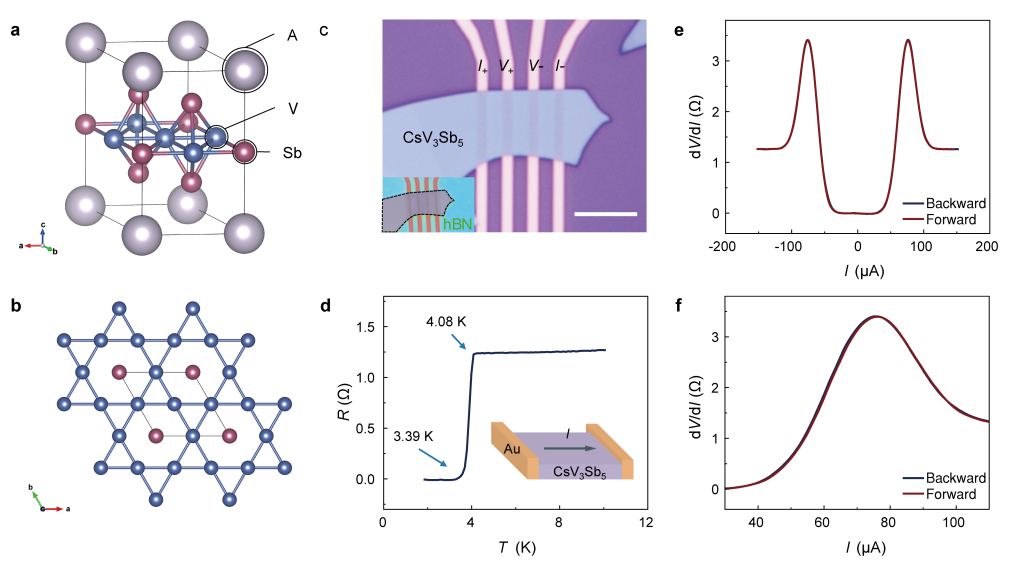
Symmetry breaking and nonreciprocal superconducting transport in RbV3Sb5, CsV3Sb5, and Td-MoTe2, including magnetic hysteresis, half-quantum flux states, and superconducting diode effects.
Thin-flake RbV3Sb5 and CsV3Sb5 devices reveal how kagome geometry, topology, and electronic correlations generate nematicity, unconventional pairing, and switchable quantum states.
Layered systems such as MnBi2Te4/Cr2Ge2Te6 and Td-MoTe2 provide tunable interfaces for engineering magnetic exchange, inversion asymmetry, and interfacial superconducting transport.
Nanowires, nanoplates, thin-flake rings, and multi-terminal devices enable gate-tunable studies of Fermi-arc spin transport, quantum interference, Hall states, and superconducting circuits.
Recent publication
arXiv 2026
By combining intrinsic devices, artificially introduced inversion-symmetry breaking, and charge-density-wave suppression, the team identified the two key symmetry conditions required for the…
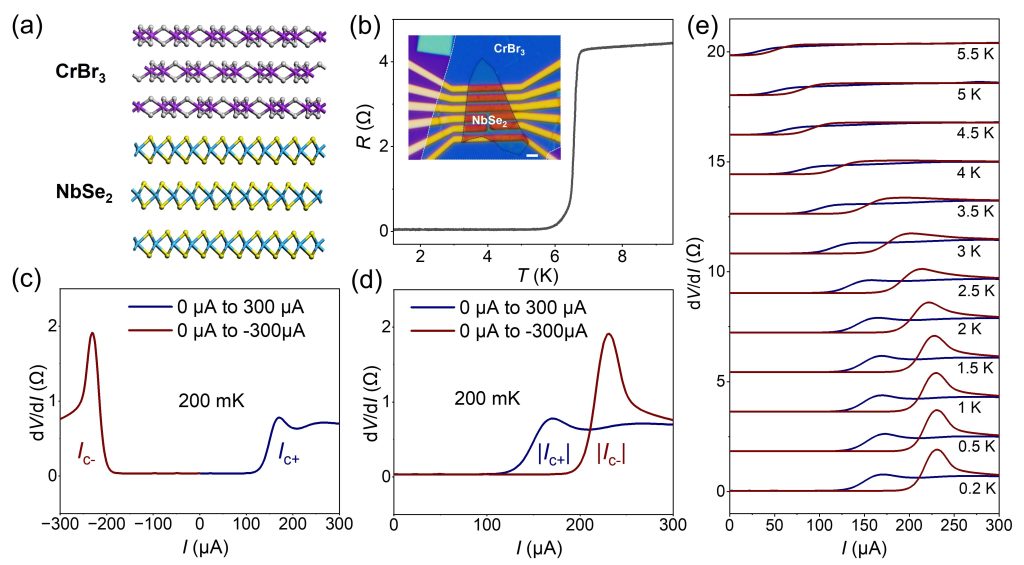
TopoQ Lab and collaborators report a 35.7% field-free superconducting diode effect in NbSe2/CrBr3 heterostructures, with polarity programmed by magnetic-field history and linked…
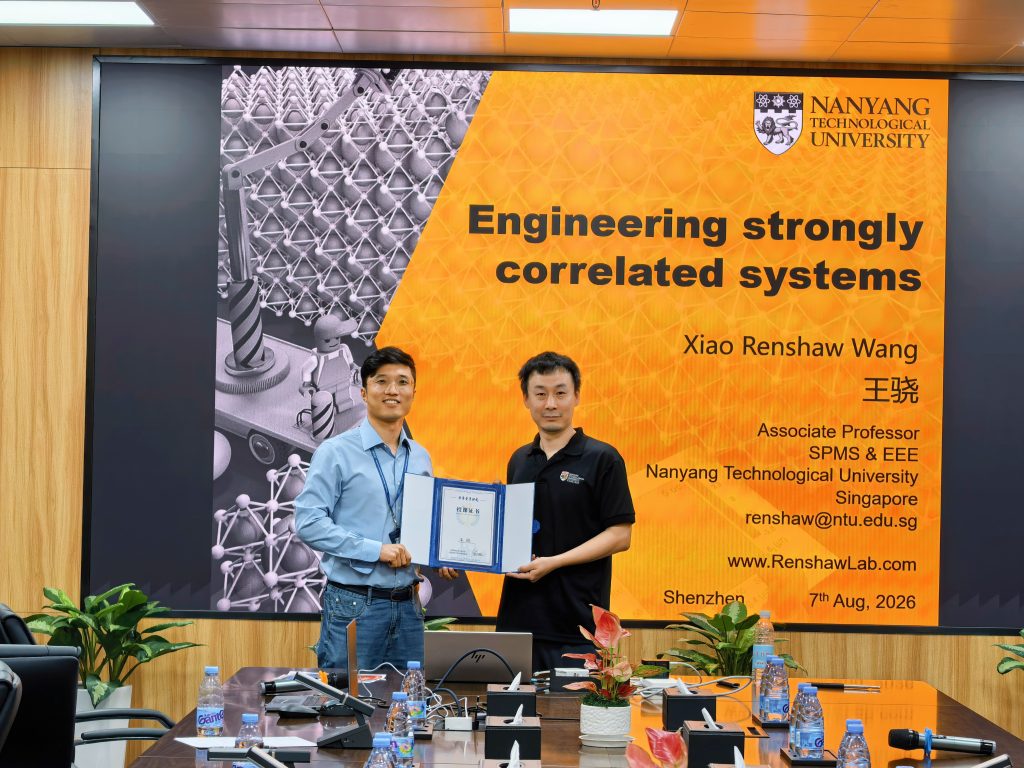
Associate Professor Xiao Renshaw WANG of Nanyang Technological University discussed how atomic-scale design, interface engineering, and reversible control can turn strongly correlated…
Professor J. Michael Kosterlitz, a Nobel laureate, met with Dr. Ben-Chuan LIN and researchers at the Academy for an in-depth exchange on…
Open positions
We welcome applications from students and postdoctoral researchers working on two-dimensional quantum materials.