New preprint: Symmetry Origins of the Field-Free Superconducting Diode Effect in the Kagome Superconductor CsV3Sb5
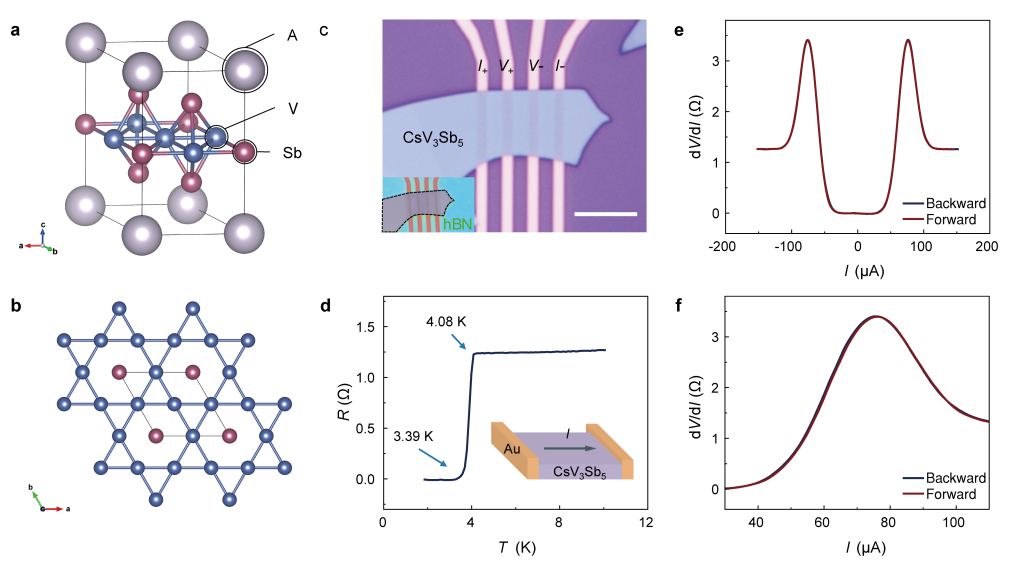
On August 27, 2026, the preprint Symmetry Origins of the Field-Free Superconducting Diode Effect in the Kagome Superconductor CsV3Sb5 was officially posted on arXiv. By combining three types of control experiments—intrinsic, artificially introduced inversion-symmetry breaking, and charge-density-wave (CDW) suppression—the team revealed the two key symmetry conditions required for the field-free superconducting diode effect in CsV3Sb5: extrinsic inversion-symmetry breaking and intrinsic CDW-related time-reversal-symmetry breaking.
Why symmetry matters
The superconducting diode effect refers to the phenomenon in which the superconducting current has different critical currents in opposite directions. At zero applied magnetic field, such nonreciprocal supercurrent requires the simultaneous breaking of inversion symmetry and time-reversal symmetry.
CsV3Sb5 is a kagome superconductor with inversion symmetry. Therefore, a key question is: Is the previously reported field-free superconducting diode effect an intrinsic property of CsV3Sb5, or does it only emerge when extrinsic inversion symmetry is broken?
This question is also related to a deeper issue: Does the time-reversal-symmetry breaking in the superconducting state of CsV3Sb5 originate from superconductivity itself, or is it inherited from CDW-related electronic order?
A controlled symmetry test
The team first investigated the intrinsic properties of hBN-encapsulated CsV3Sb5 devices, with nearly all fabrication steps performed under an inert atmosphere to minimize extrinsic effects arising from air exposure. Across devices with different thicknesses ranging from ~20 to 75 nm, the critical currents in the positive and negative directions remained symmetric, and no intrinsic field-free superconducting diode effect was observed.
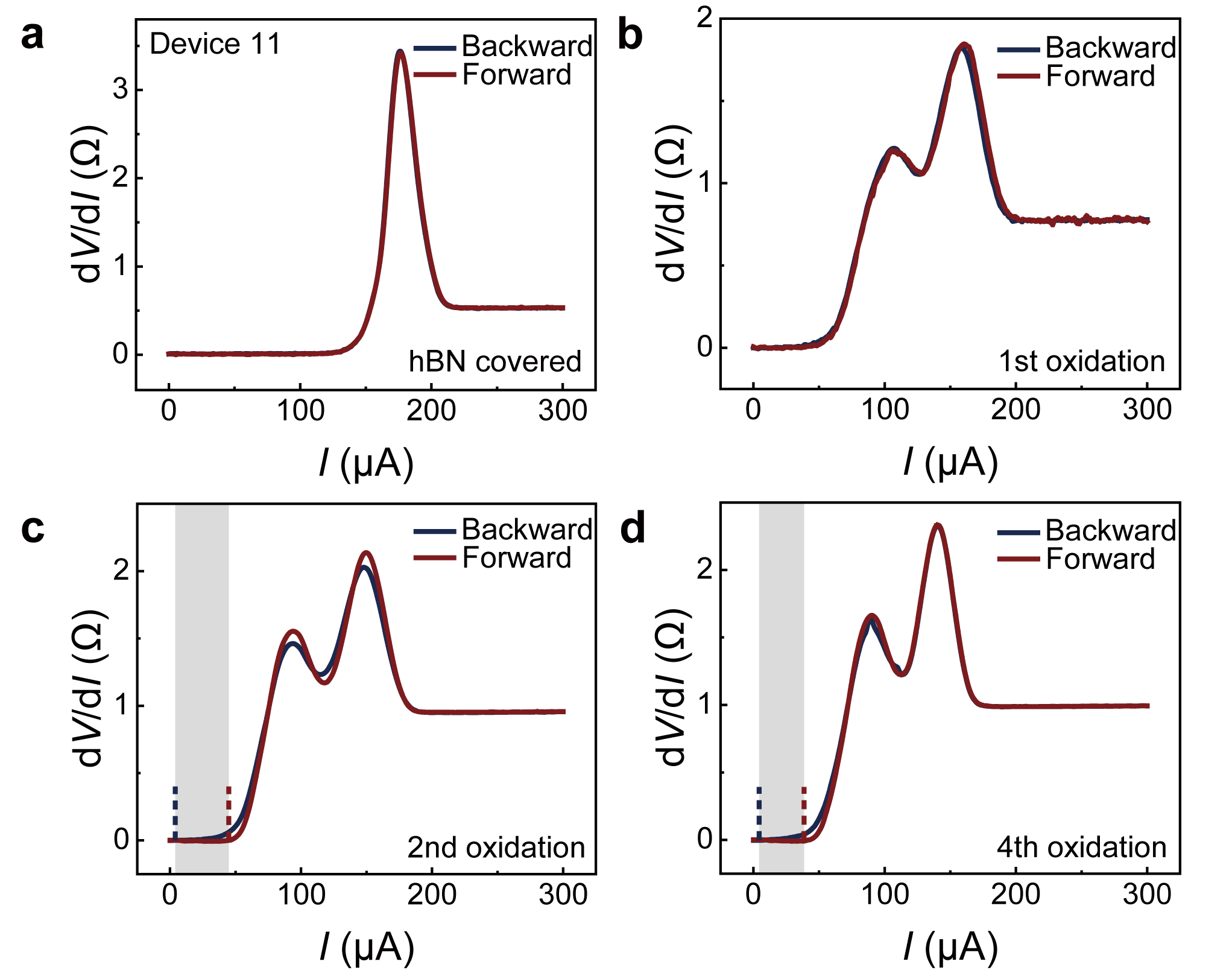
The team then deliberately broke inversion symmetry through two independent approaches: surface oxidation and asymmetric etching. Both methods successfully activated a pronounced field-free superconducting diode effect, demonstrating that inversion-symmetry breaking is among the necessary conditions for generating this effect.
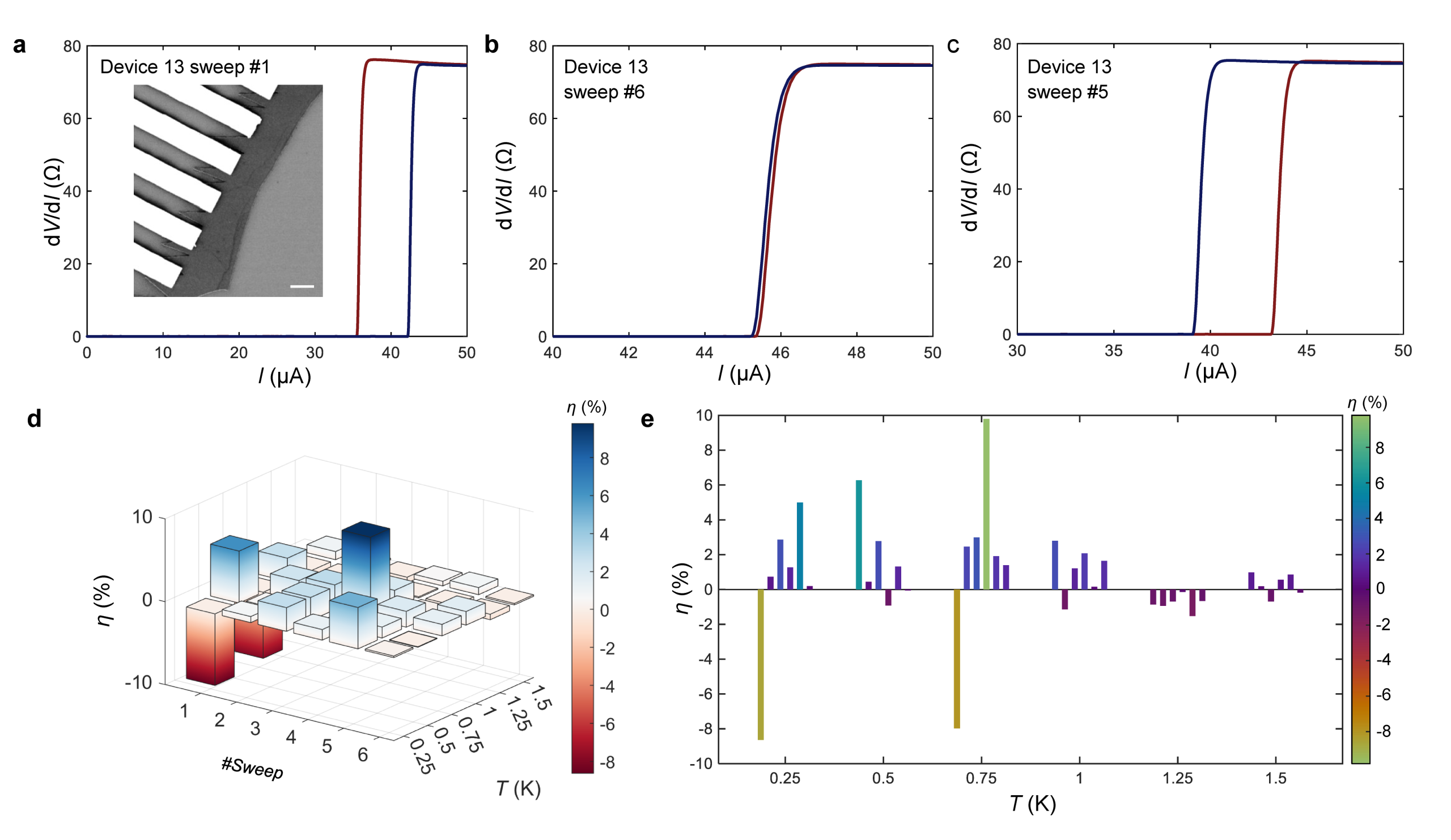
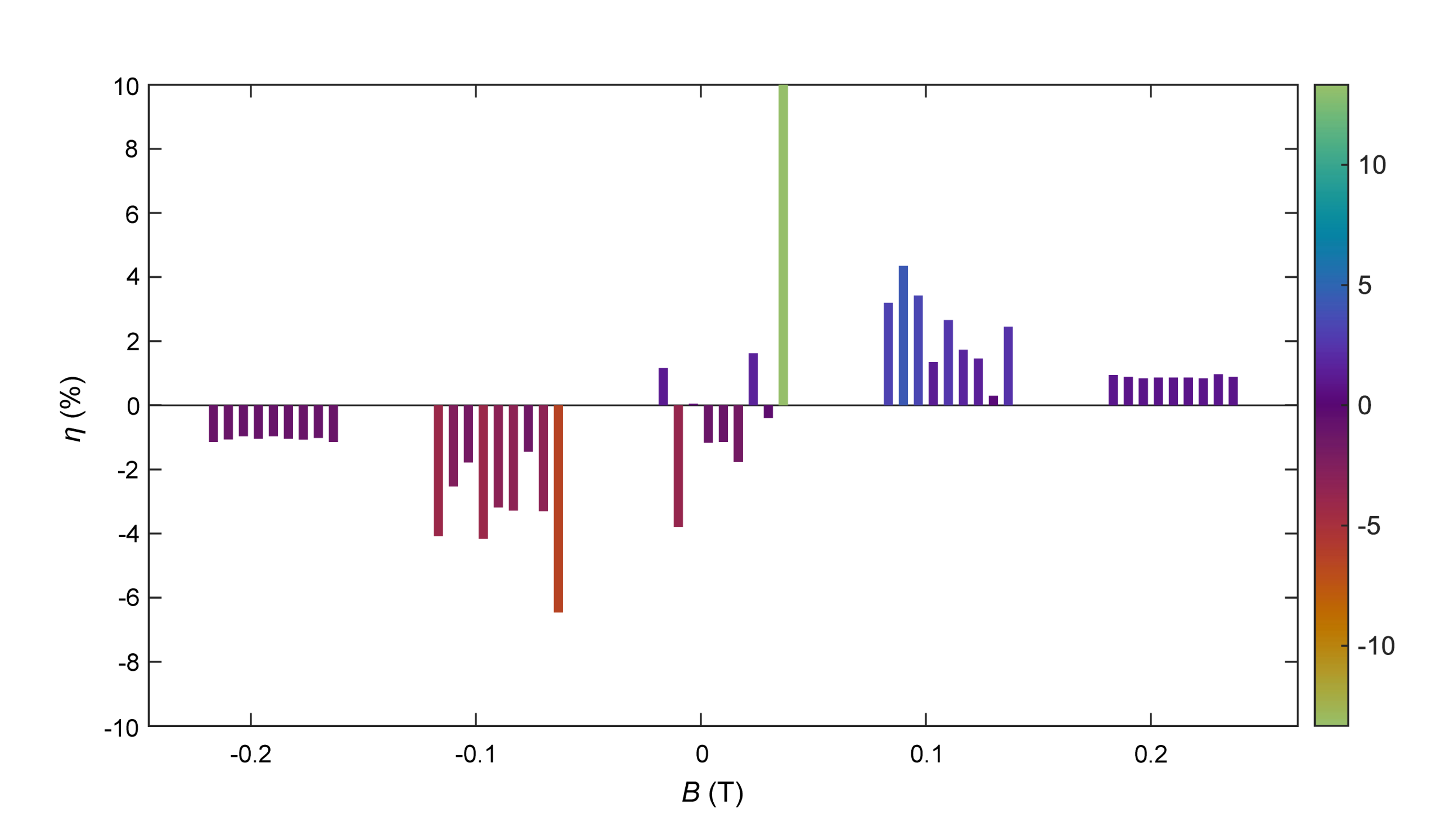
More importantly, the field-free superconducting diode effect was found to be stochastic. Even under identical experimental conditions, both the magnitude and polarity of the diode efficiency fluctuate randomly across repeated measurements, and the polarity could even reverse. After applying a small out-of-plane magnetic field of 0.2 T, the random fluctuations were gradually suppressed, and the diode polarity became stabilized.
This result indicates the existence of metastable time-reversal-symmetry-breaking domain configurations that can undergo reconfiguration, while the external magnetic field can “train” these domains.
CDW as a key clue to time-reversal-symmetry breaking
To further determine the origin of the time-reversal-symmetry breaking, the team introduced Ti-doped CsV3-xTixSb5 (x = 0.24), in which long-range CDW order is suppressed through Ti doping.
The results show that even when the same oxidation or etching procedures used for pristine CsV3Sb5 were applied to break inversion symmetry, no field-free superconducting diode effect was observed in the Ti-doped samples.
This key control experiment demonstrates that inversion-symmetry breaking provides the polarity required for the superconducting diode effect, while CDW-related time-reversal-symmetry breaking provides another essential condition.
These findings not only reveal a stochastic field-free superconducting diode effect and its CDW-related time-reversal-symmetry-breaking origin in a kagome superconductor with deliberately engineered inversion-symmetry breaking, but also provide a new route toward constructing controllable, low-dissipation nonreciprocal superconducting devices.
Figure credits: Xin-Jie Liu et al., “Symmetry Origins of the Field-Free Superconducting Diode Effect in the Kagome Superconductor CsV3Sb5,” arXiv:2608.26022. Reproduced without modification under CC BY-NC-ND 4.0.