New preprint: Large Field-Free Superconducting Diode Effect with Nonmonotonic Polarity Reversals in NbSe2/CrBr3 Heterostructures
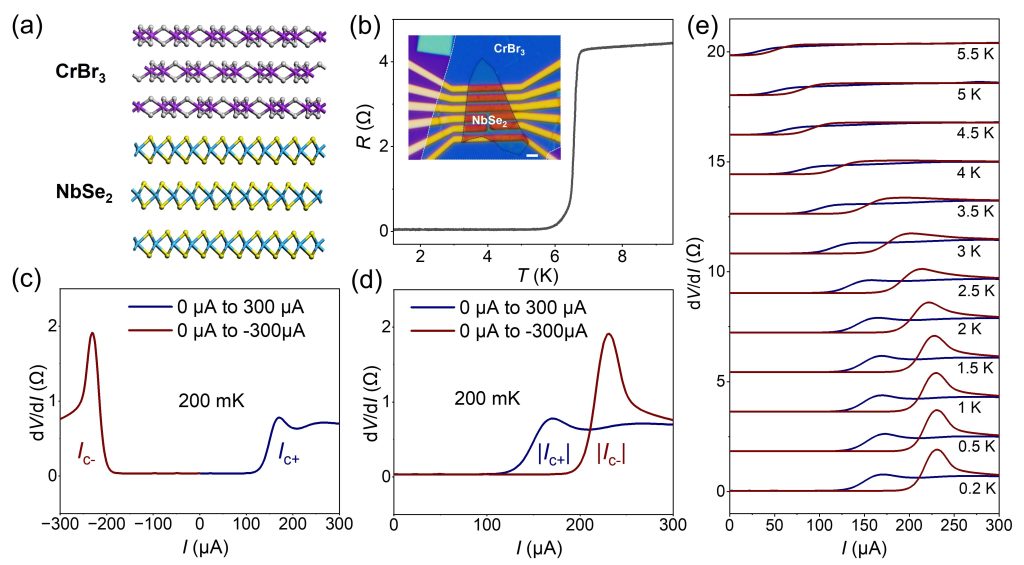
On August 20, 2026, the preprint Large Field-Free Superconducting Diode Effect with Nonmonotonic Polarity Reversals in NbSe2/CrBr3 Heterostructures was posted online on arXiv. The study reports a large superconducting diode effect at zero applied magnetic field in a van der Waals NbSe2/CrBr3 heterostructure. After magnetic training, the zero-field diode efficiency reaches 35.7%, while the rectification polarity can be programmed through magnetic-field history.
Why this matters
A superconducting diode supports a larger dissipationless current in one direction than in the other. Most demonstrations require a continuously applied magnetic field, which complicates device operation. A strong and controllable response at zero field is therefore an important step toward superconducting rectifiers and other low-power circuit elements.
The new platform brings together the strong Ising spin-orbit coupling and trigonal warping of NbSe2 with a tunable interfacial exchange field from the layered magnetic insulator CrBr3. This combination breaks the symmetries needed for nonreciprocal supercurrent without requiring an applied field during operation.
A large diode effect at zero field
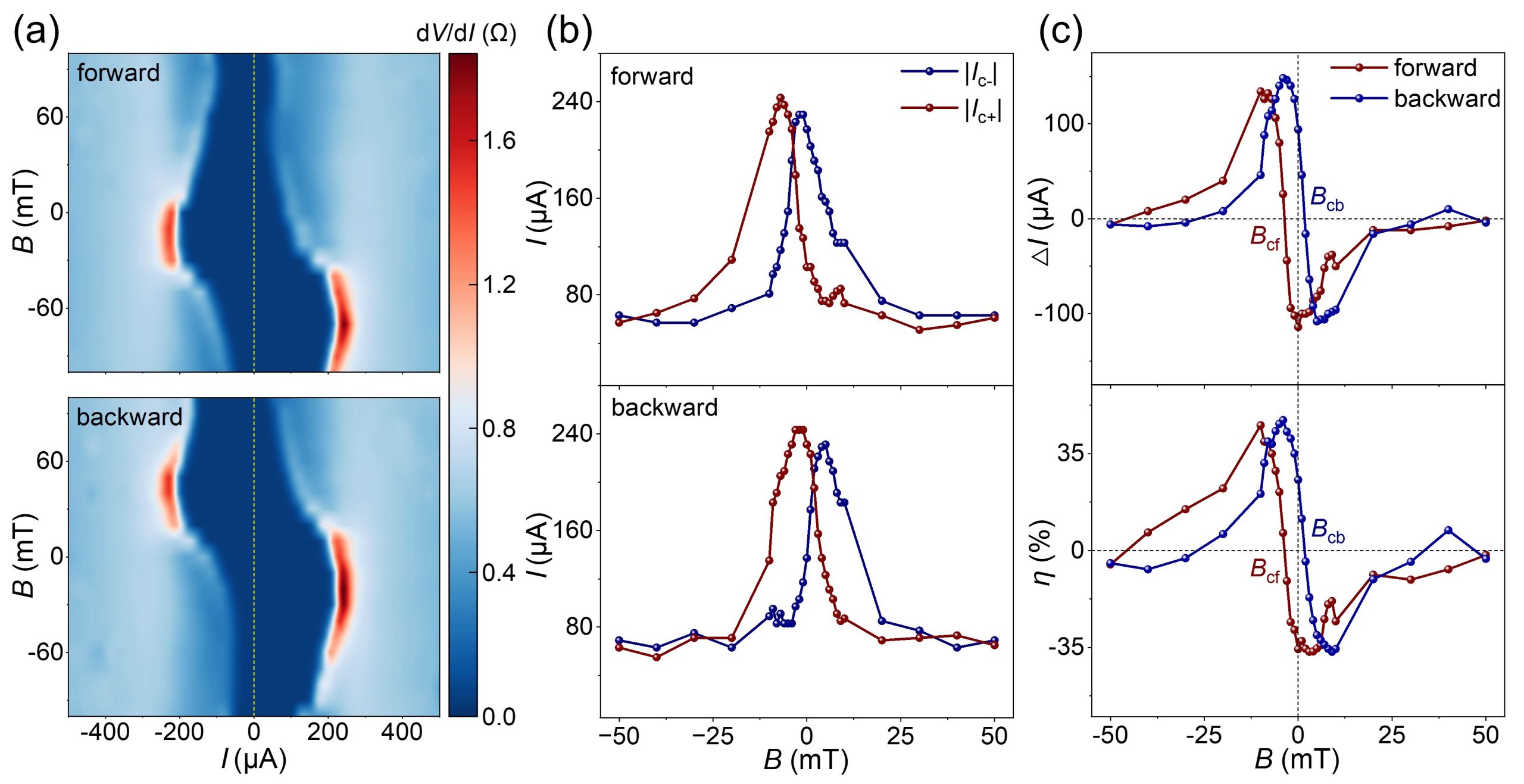
The heterostructures show unequal positive and negative critical currents throughout the superconducting regime. Following magnetic training, the zero-field diode efficiency reaches 35.7%, placing the result among the largest field-free superconducting diode effects reported to date. The devices also produce stable zero-field rectification, and the output polarity reverses when the direction of the training field is changed.
Magnetic history programs the polarity
When a perpendicular magnetic field is swept, the diode response does not simply follow the field or reverse once at zero. Instead, its polarity changes nonmonotonically and follows different paths for forward and backward sweeps. The resulting hysteresis gives the device a memory of its magnetic-field history even after the applied field returns to zero.
A different microscopic route to nonreciprocity
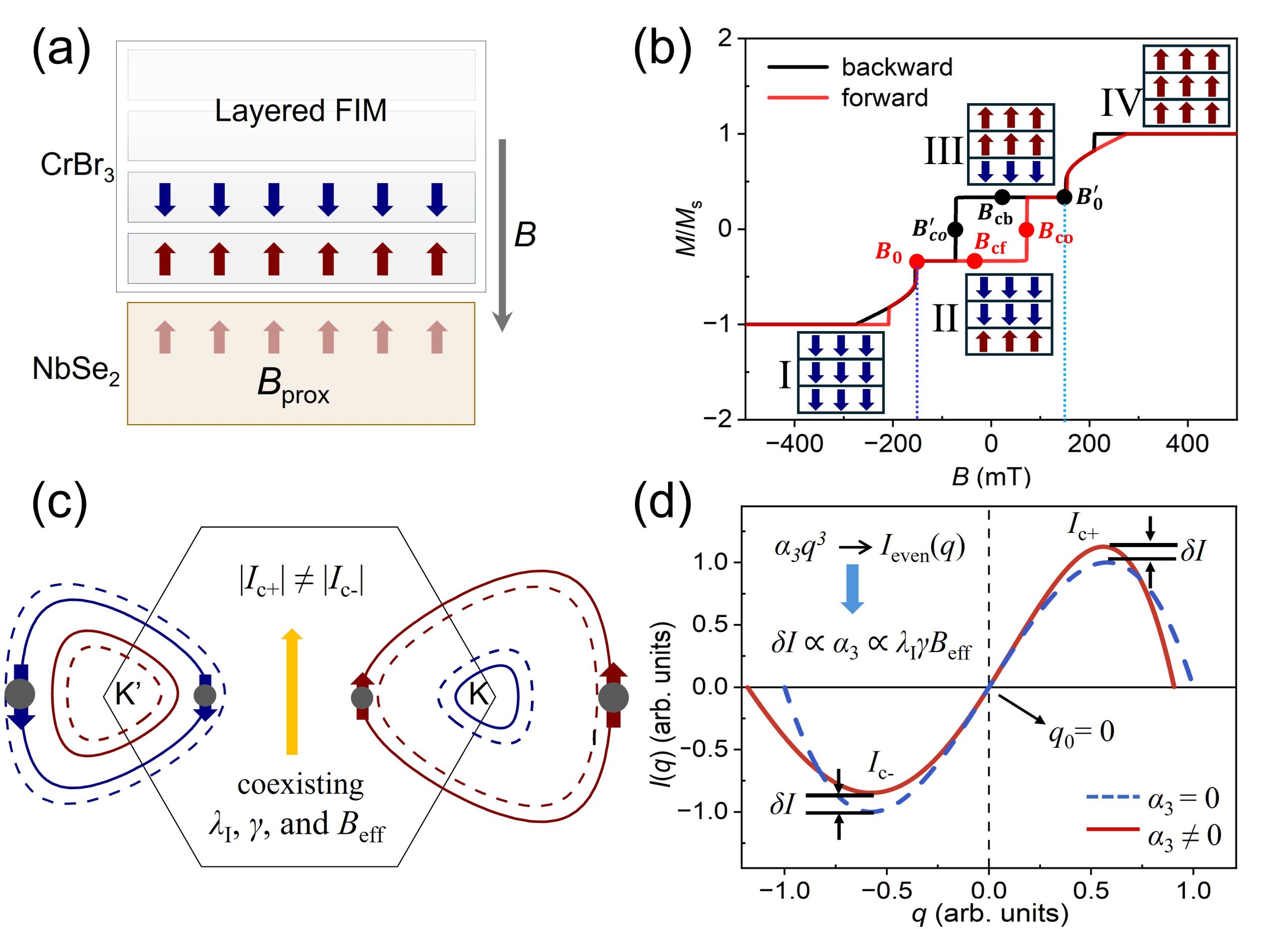
Transport measurements, polar RMCD magnetic characterization, first-principles calculations, micromagnetic simulations, and a generalized Ginzburg-Landau theory point to layered ferrimagnetism in CrBr3. Ferromagnetic and antiferromagnetic interlayer couplings coexist, allowing the CrBr3 layer nearest NbSe2 to evolve differently from, and sometimes oppose, the net magnetization of the full magnetic stack. This produces a history-dependent interfacial exchange field.
The theoretical analysis identifies a leading symmetry-allowed term that is cubic and odd in Cooper-pair momentum. It makes the two current-carrying branches depair asymmetrically, producing unequal critical currents while the equilibrium condensate remains at zero momentum. This distinguishes the observed diode effect from common helical mechanisms based on a finite-momentum equilibrium state.
Collaboration and outlook
The theoretical framework, first-principles calculations, and micromagnetic simulations were developed in close collaboration with Associate Professor Tong ZHOU‘s group at the Eastern Institute of Technology, Ningbo. Associate Professor Ya-Qing BIE‘s group at Sun Yat-sen University carried out the optical magnetic characterization of CrBr3.
The results show that the magnetic state immediately at an interface can matter more than the total magnetization of a layered magnet. This creates opportunities to engineer superconducting nonreciprocity, magnetic memory, and other proximity effects within a common van der Waals material platform.
Figures are reproduced from the preprint under the CC BY-NC-ND 4.0 license.