Associate Professor Xiao Renshaw WANG Discusses Engineering Strongly Correlated Systems at SIQA
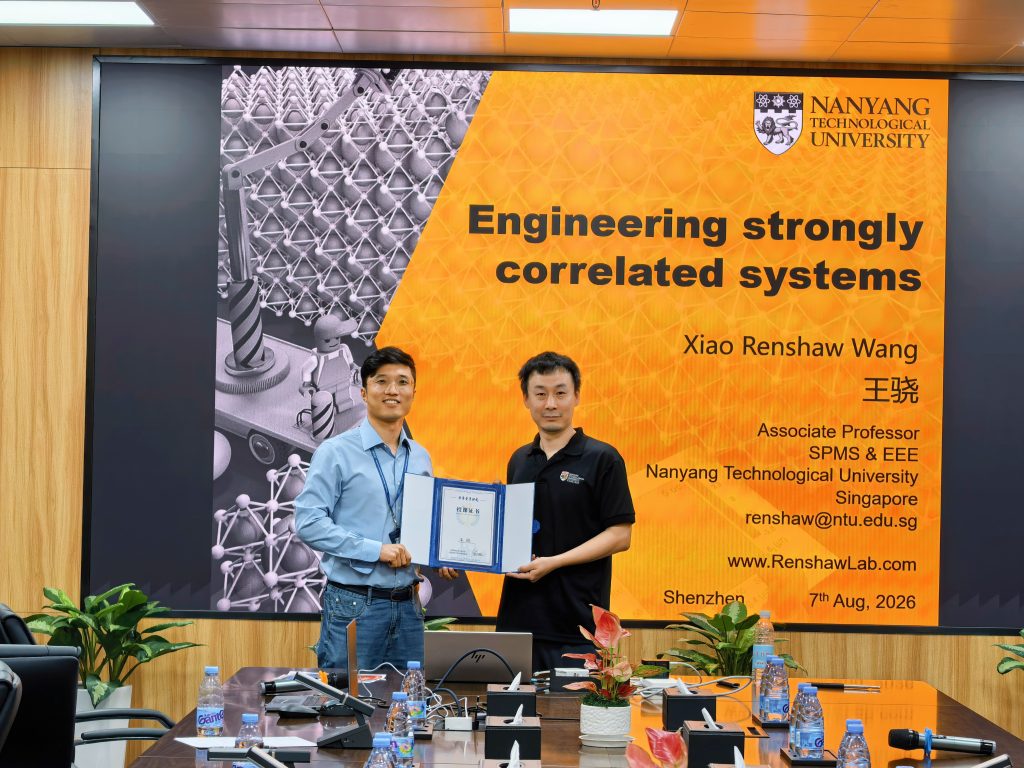
On the afternoon of August 7, 2026, the 14th Zhuoyue Quantum Salon of the year—and the 116th in the series—was held at Shenzhen International Quantum Academy (SIQA). At the invitation of Academician Dapeng YU, Associate Professor Xiao Renshaw WANG of Nanyang Technological University (NTU), Singapore, delivered a seminar titled Engineering of Strongly Correlated Systems. Dr. Ben-Chuan LIN hosted and moderated the seminar.
Associate Professor WANG is a tenured faculty member in NTU’s School of Physical and Mathematical Sciences and School of Electrical and Electronic Engineering. His research spans low-dimensional strongly correlated systems, materials fabrication, magnetism, and spintronic and electronic devices.
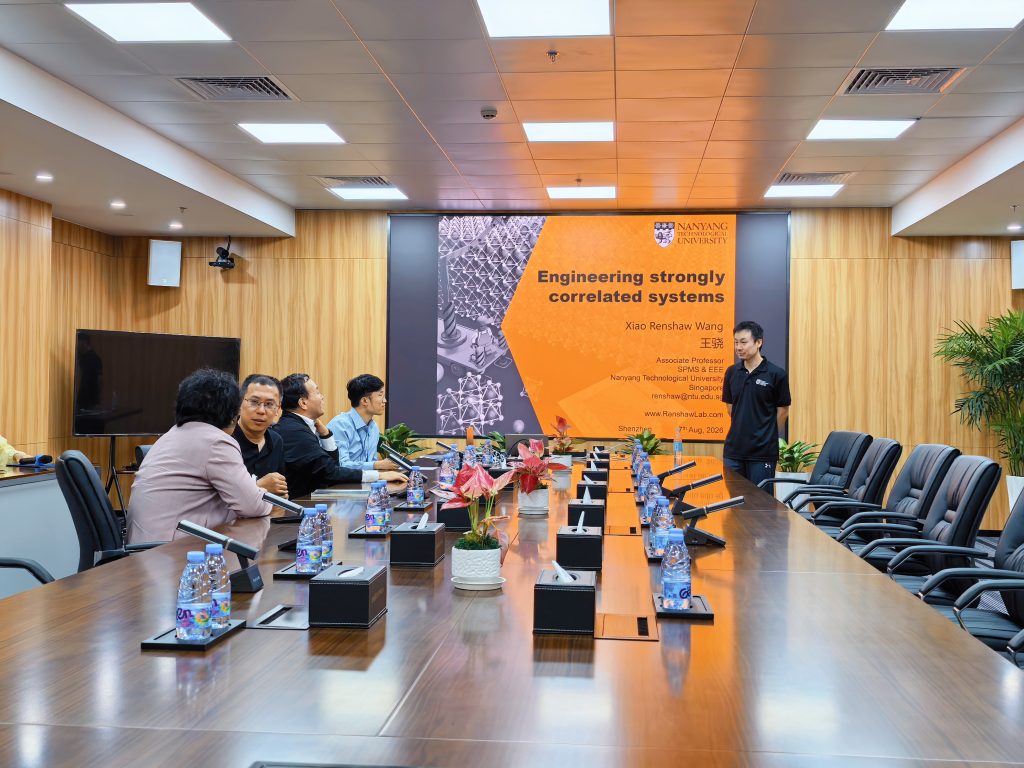
As conventional semiconductor technologies approach their fundamental physical limits, researchers are looking to new materials and architectures for functions that conventional semiconductors cannot readily provide. Associate Professor WANG presented strongly correlated materials as a particularly rich platform for that effort.
In these systems, charge, spin, orbital, and lattice degrees of freedom can interact strongly, giving rise to phases and functions such as ferroelectricity, superconductivity, and magnetism. Complex oxides are especially versatile: their coupled degrees of freedom create room not only to discover emergent behavior, but also to design and control it.
Associate Professor WANG described how atomic-scale structural design, artificial oxide superlattices, and heterointerfaces can reshape charge distributions and electronic correlations. He also discussed scanning SQUID microscopy as a sensitive tool for probing magnetic transitions and functional behavior in ultrathin oxide systems.
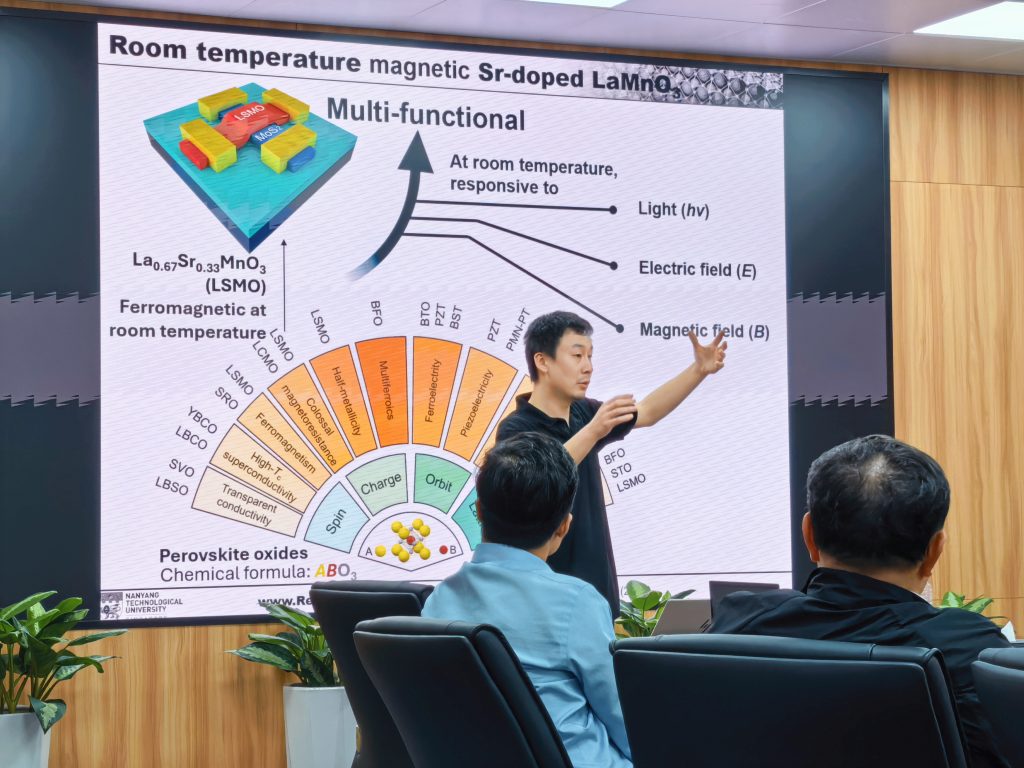
A central theme of the seminar was active and reversible control. Through ionic-liquid gating, oxygen-ion migration, and electric fields, researchers can reconfigure ionic arrangements and electronic states, making material properties electrically programmable. Associate Professor WANG framed this as a shift from observing emergent phenomena to deliberately engineering functions for electronic devices.
The seminar connected materials, structures, functions, and devices in a coherent experimental framework. It showed how thin-film synthesis, interface engineering, advanced characterization, and external-field control can work together to manipulate the magnetic and electronic properties of low-dimensional correlated materials.
Throughout the session, Dr. LIN kept the exchange anchored in both the underlying physics and the experimental questions relevant to device development. As host and moderator, he drew connections among the ideas in the seminar and guided the discussion toward how correlated phases can be identified, controlled, and further optimized. Faculty members and students joined the conversation with questions about materials design, measurement strategies, and functional control.
The discussion continued after the presentation, creating a productive setting for exchanges on complex oxides, low-dimensional materials, and future device concepts, as well as for further interaction across related research areas.