Dr. Jia-Xin Yin Speaks on Topological Pair-Density Waves at Shenzhen International Quantum Academy
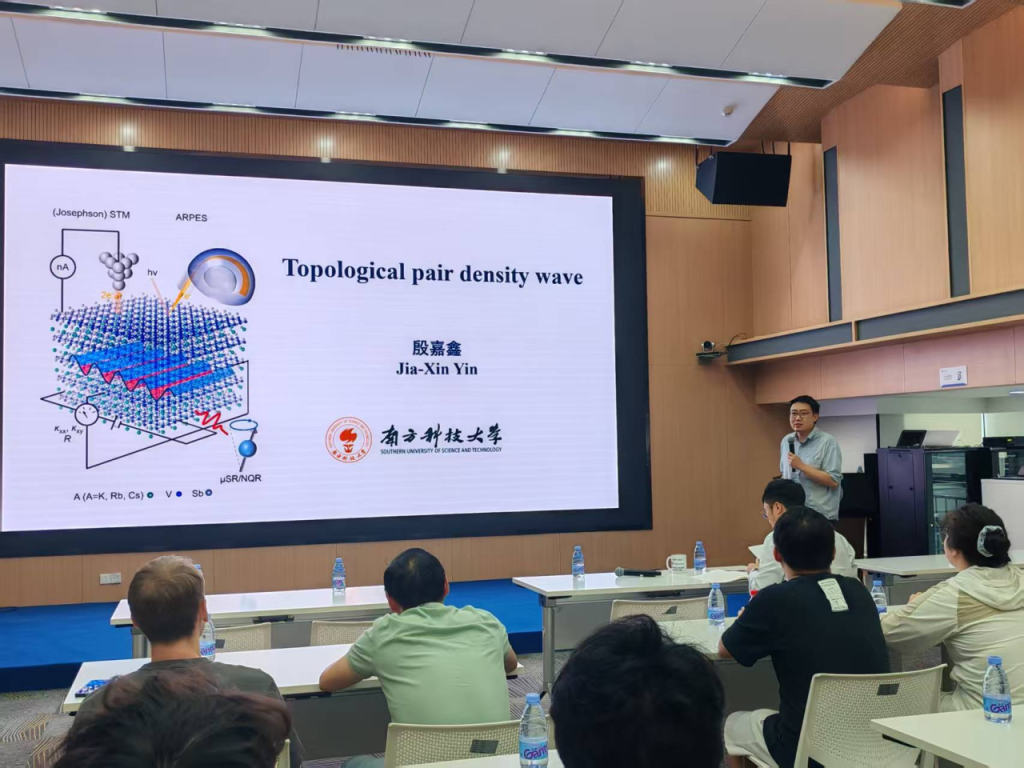
Dr. Jia-Xin Yin is an experimental condensed-matter physicist at Southern University of Science and Technology. His research uses scanning tunneling microscopy to study emergent quantum states in topological and kagome materials, with particular attention to unconventional superconductivity.
On April 15, 2026, Dr. Yin visited the Shenzhen International Quantum Academy to speak at the 106th Zhuoyue Quantum Salon. His seminar, Topological Pair-Density Waves, explored one of the most intriguing emerging states in kagome superconductors.
Dr. Ben-Chuan LIN hosted the seminar. The subject is closely connected to TopoQ Lab’s work on kagome systems, unconventional pairing, and topological superconductivity, making the visit a natural opportunity for Dr. Yin and Dr. Lin to compare experimental perspectives on how these states can be recognized in real materials.
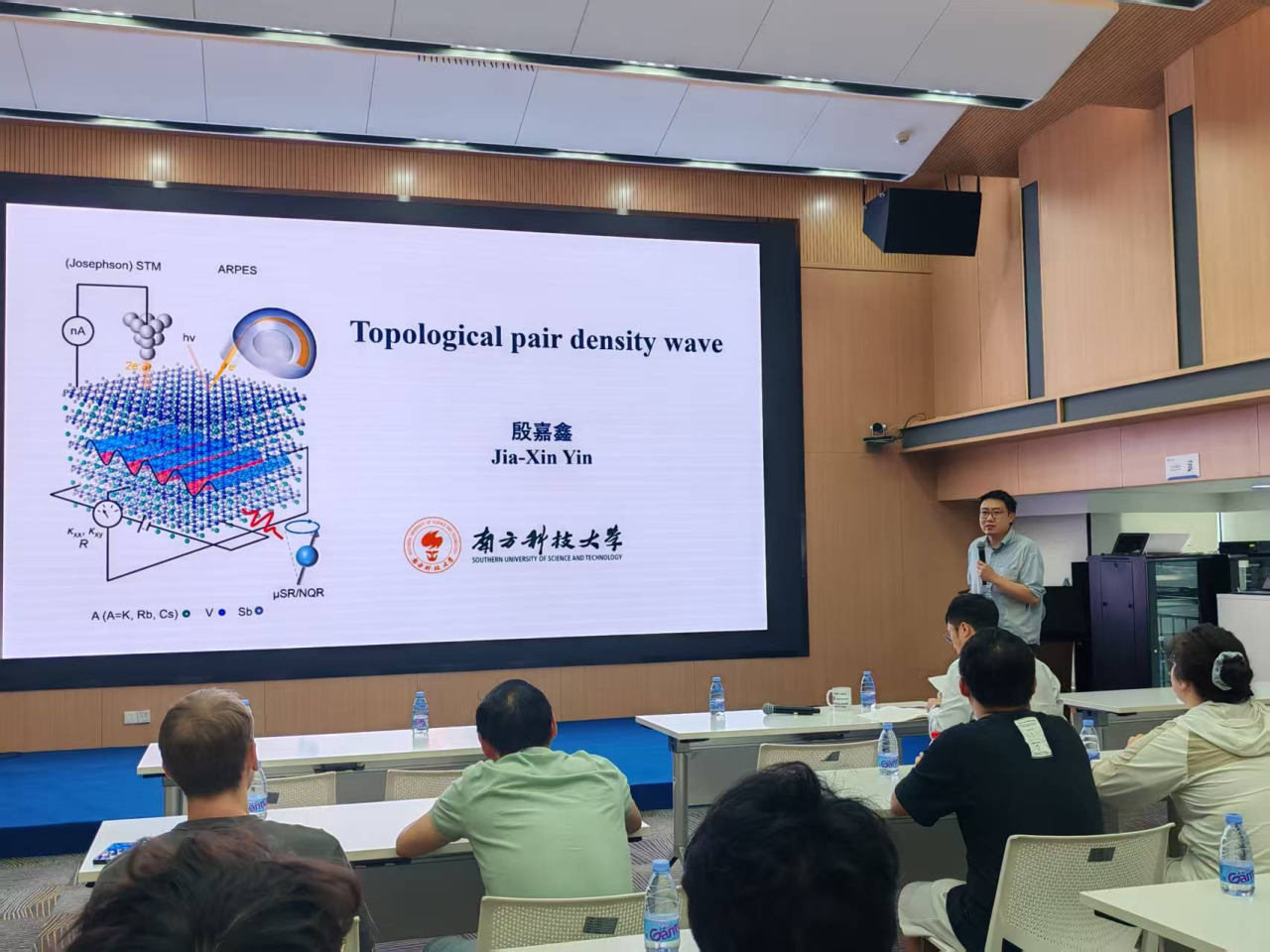
From finite-momentum pairing to topology
Dr. Yin began with the physics of finite-momentum pairing, moving from conventional BCS superconductivity through Fulde-Ferrell-Larkin-Ovchinnikov states to pair-density waves. He then showed how the geometry and electronic structure of the kagome lattice, including its van Hove singularities, can provide a setting for a topological pair-density wave, while also outlining the experimental challenges involved in detecting such a state.
Dr. Yin went on to discuss his team’s work on the vanadium-based kagome superconductors AV3Sb5 (A = K, Rb, or Cs). Using Josephson scanning tunneling microscopy, the team observed a chiral pair-density wave in work published in Nature in 2024. The experiments revealed field-switchable chirality, Bogoliubov Fermi arcs, and pair breaking by non-magnetic impurities, offering a closer look at how the topological pair-density wave competes and coexists with charge-density-wave order.
Continuing the conversation
In the discussion chaired by Dr. Lin, Dr. Yin and participants explored the physical picture behind chirality switching, the similarities and differences between a topological pair-density wave and d+id superconductivity, the practical details of STM measurements, and how the search might be extended to other kagome materials.
The discussion connected Dr. Yin’s expertise in real-space imaging with TopoQ Lab’s search for experimental signatures of unconventional and topological superconductivity, and pointed to several shared questions that can be pursued across different materials and measurement techniques.
This article is based on the Chinese-language story published by the Shenzhen International Quantum Academy.